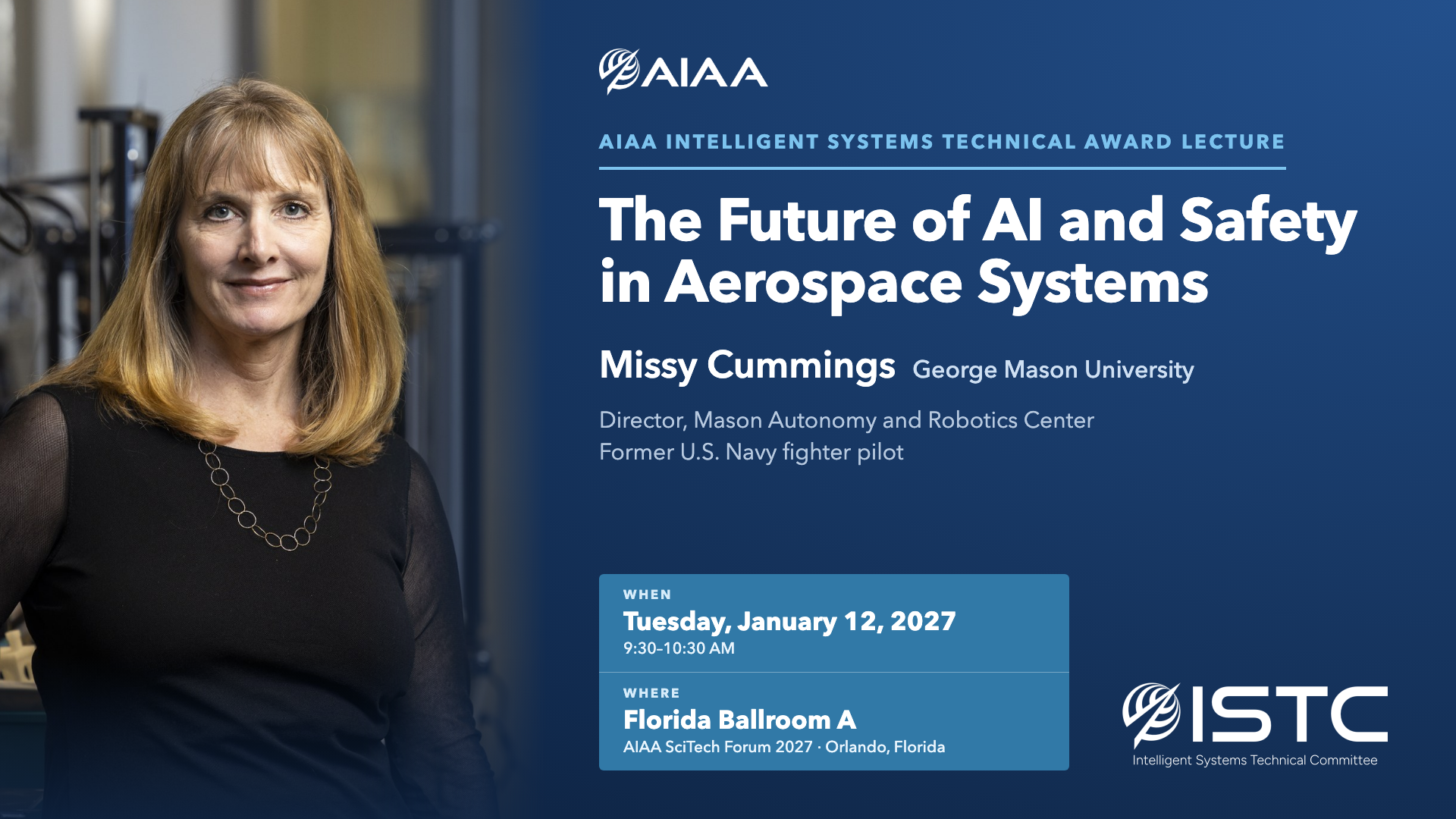
The AIAA Intelligent Systems Technical Committee (ISTC) is concerned with the application of Intelligent System (IS) technologies and methods to aerospace systems, the verification and validation of these systems, and the education of the AIAA membership in the use of IS technologies in aerospace and other technical disciplines.
The Intelligent Systems Technical Committee addresses the application of Intelligent System (IS) technologies and methods to aerospace systems, the verification and validation of these systems, and the education of the AIAA membership in the use of IS technologies in aerospace and other technical disciplines.
ISTC Focus: Commercial and military aerospace systems, and those ground systems that are part of test, development, or operations of aerospace systems. Technologies which enable safe and reliable operation of complex aerospace systems or sub-systems with minimal or no human intervention (autonomy), or collaborative synthetic-human agent teams are of interest. These include, but are not limited to: autonomous and expert systems, discrete planning/scheduling algorithms, intelligent data/image processing, learning and adaptive techniques, data fusion and reasoning, and knowledge engineering.
Members of the ISTC have experience in developing and managing aerospace systems involving knowledge engineering, knowledge acquisition, verification/validation of knowledge based systems, neural networks, and expert systems, as well as the use of artificial intelligence concepts/techniques to support natural language interfaces, image understanding, planning/scheduling, and data fusion.
If you would like more information, or are interested in joining the ISTC, please see the Our Mission page!
Yearly workshop
2026 Intelligent Systems Workshop
Digital Transformation Center, August 12-13, 2026 (save the date!)
The 10th annual Intelligent Systems Workshop will take place August 12-13, 2026, at the Digital Transformation Center in Dayton, OH.
This year’s workshop themes:
Autonomy at Scale
Human Interaction
Counter UAS
Precision Navigation
AI's Impact on Workforce
Registration is open! ($20 Landing Fee until August 1st, then $75) Register here!
(Includes lunch on Day 1. No fee for student posters.)
Abstract: This talk presents research on control and optimization for unmanned aircraft systems (UAS), with an emphasis on enabling safe, efficient, and intelligent autonomous operations. The talk will first discuss distributed formation control and collision avoidance for multi-UAV systems, including optimal control strategies for coordinated flight and safe separation. Then, it will introduce physics-informed learning approaches that integrate model predictive control, system dynamics, and stability considerations to enable efficient quadcopter control. The talk will also explore system-level optimization for Advanced Air Mobility, including vehicle assignment, routing, and coordination between ground and air transportation. Overall, these studies demonstrate how control theory, mathematical optimization, and artificial intelligence can be integrated to support the development of next-generation UAS.
Bio: Dr. Shuting Yang is an Assistant Professor of Aerospace Science Engineering at Tuskegee University. She received her B.S., M.S., and Ph.D. in Aeronautics and Astronautics Engineering from Purdue University. Her research focuses on advanced air mobility, unmanned aerial systems, flight dynamics and control, mathematical optimization, and artificial intelligence. Her work spans system-level modeling and optimization of multimodal transportation networks, distributed control and collision avoidance for multi-UAV systems, and physics-informed and AI-assisted control methods for autonomous flight. Her current research seeks to bridge optimization, control theory, machine learning, and experimental flight testing to develop safe and intelligent aerospace systems while expanding hands-on research opportunities for students.
News: 2026 Sept 14, 5:35pm EDT (by Cat McGhan)
ISTC Technical Seminar Series
Don’t miss Dr. Huy T. Tran’s seminar Thursday September 17 at 1:00pm ET on Zoom!
Speaker: Huy T. Tran, PhD
University of Illinois Urbana-Champaign
Date/time: Thursday, September 17th, 2026 – 1:00pm-2:00pm Eastern time
Abstract: Multi-agent systems can help with many real-world problems, such as using drones for wildfire management. Multi-agent reinforcement learning (MARL) has shown promise for optimizing decision polices for such systems. However, current algorithms do not scale well to large systems, struggle to adapt to new ad hoc teams, and have limited guarantees. In this talk, I will first discuss our work exploring the bias-variance tradeoff for scaling MARL to large teams. I will then present an algorithm for agents to adapt to new teammates with no online learning. Finally, I will introduce work integrating contraction theory with RL to provide stability guarantees.
Bio: Huy T. Tran is an Assistant Professor in theAerospace Engineering department at the University of Illinois Urbana-Champaign, Urbana, IL. He received a BS degree from North Carolina State University, Raleigh, NC in 2008, and an MS degree from the University of Wisconsin–Madison, Madison, WI, in 2010, both in Mechanical Engineering. He received MS and PhD degrees in Aerospace Engineering from the Georgia Institute of Technology, Atlanta, GA, in 2014 and 2015. He has also worked as a multi-disciplinary systems engineer for the MITRE Corporation. He is the director of the Laboratory for Intelligent Robots and Agents (LIRA) at Illinois. His research currently focuses on autonomy in uncertain and unstructured environments, with an emphasis on reinforcement learning, multi-agent systems, and controls applied to robotics and intelligent transportation systems. He is an affiliate of the University of Illinois Coordinated Science Laboratory, Center for Autonomy, Illinois Robotics Group, and Smart Transportation Infrastructure Initiative. He is a member of IEEE, the IEEE Multi-Robot Systems Technical Committee, and AIAA.
More announcements are available on the Announcements page.